Just noticed amazon has dropped this further to the lowest price ever. I have one and recommend it (outstanding reviews also).
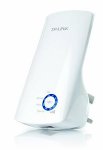
Upgraded version compatible with all broadband routers BT/SKY/TalkTalk/Virgin Media etc
Boosts wireless signal to previously unreachable or hard-to-wire areas flawlessly
Easily expand wireless coverage at a push of WPS button
Extra fast Ethernet port for wired device
300 Mbps wireless data rates suitable for video streaming, online gaming and internet calling
Top comments
FREEZIN WOLF
11 Jun 166#2
Not surprised they've dropped the price. They are rubbish!
cullies
11 Jun 163#22
I use a TP link POWERLINE extender which works(uses the house electrical circuit), this rubbish thing on here does NOT!!
No every time you add a repeater you halve the bandwidth. So if you have a 40Mb connection roughly after using one repeater the devices connecting via the repeater will have 20Mb bandwidth to play with. Also to use a repater correctly you need to put them where the signal is very good. They don't magically enhance the signal they just repeat the signal on from where it's still strong. If you position a repeater incorrectly then it's mostly useless.
The reason repeaters introduce a heavy bandwidth loss is due to the packet hops. I've nicked this description from someone else >
"Count the packet hops.
"PC and router = 1 request and 1 reply.
PC, repeater = 1 PC request to repeater, 1 repeater to router, 1 router to repeater and 1 repeater to PC."
The quick answer is you don't want to do any of what you asked.
The whole Internet is based on the TCP/IP protocol, which was invented around 1973/74 and introduced in 1983. So we're talking about a 40 year old protocol, which was designed for the Telephony technology of the day, eventually we'll move to more efficient protocols such as ones that use Named Data Networking and Linear Network Coding, long way off though.
WBRacing
11 Jun 163#12
Yeah but an arrogant sounding a$$ on a deal forum has said that it is rubbish, so you and they are clearly all wrong.
The fact is (as a helpful poster, like fishmaster has explained) they aren't great. But can serve a purpose if switched on as and when needed, which is what I do.
All comments (69)
arma_gera
11 Jun 16#1
FREEZIN WOLF
11 Jun 166#2
Not surprised they've dropped the price. They are rubbish!
arma_gera to FREEZIN WOLF
11 Jun 16#4
you are entitle to share your opinion of course... at least 2469 more have given this product 4/5 stars and i also have one and happy with it.
Zatos
11 Jun 16#3
Can you have 2 of these fitted? I mean one towards the end of the routers signal range and then another towards the end of the first wifi boosters range, technically doubling the routers range.
fishmaster to Zatos
11 Jun 163#10
No every time you add a repeater you halve the bandwidth. So if you have a 40Mb connection roughly after using one repeater the devices connecting via the repeater will have 20Mb bandwidth to play with. Also to use a repater correctly you need to put them where the signal is very good. They don't magically enhance the signal they just repeat the signal on from where it's still strong. If you position a repeater incorrectly then it's mostly useless.
The reason repeaters introduce a heavy bandwidth loss is due to the packet hops. I've nicked this description from someone else >
"Count the packet hops.
"PC and router = 1 request and 1 reply.
PC, repeater = 1 PC request to repeater, 1 repeater to router, 1 router to repeater and 1 repeater to PC."
The quick answer is you don't want to do any of what you asked.
The whole Internet is based on the TCP/IP protocol, which was invented around 1973/74 and introduced in 1983. So we're talking about a 40 year old protocol, which was designed for the Telephony technology of the day, eventually we'll move to more efficient protocols such as ones that use Named Data Networking and Linear Network Coding, long way off though.
mistermoneysaver
11 Jun 162#5
I have one of these. OK as an Ethernet extender, but i concur its rubbish as a WiFi extender.
FREEZIN WOLF
11 Jun 16#6
Congratulations
arma_gera
11 Jun 162#7
cheers!
schnecker
11 Jun 161#8
use one of these and very happy with it. have some heat.

![Fresh Breakfast Meat Box (Using code) @ Campbells Meat [Haggis / Lorne Sausage / Bacon / Black Pudding & More]](/images/topics/208684_1.jpg)


































![[Xbox One] Q. u. b. e: Director's Cut on Deals with Gold](/images/topics/208716_1.jpg)














Opening post
Upgraded version compatible with all broadband routers BT/SKY/TalkTalk/Virgin Media etc
Boosts wireless signal to previously unreachable or hard-to-wire areas flawlessly
Easily expand wireless coverage at a push of WPS button
Extra fast Ethernet port for wired device
300 Mbps wireless data rates suitable for video streaming, online gaming and internet calling
Top comments
This is what you need;
https://www.amazon.co.uk/gp/product/B00ECBRGW8/ref=oh_aui_detailpage_o01_s00?ie=UTF8&psc=1
The reason repeaters introduce a heavy bandwidth loss is due to the packet hops. I've nicked this description from someone else >
"Count the packet hops.
"PC and router = 1 request and 1 reply.
PC, repeater = 1 PC request to repeater, 1 repeater to router, 1 router to repeater and 1 repeater to PC."
http://www.cnet.com/forums/discussions/do-repeaters-bridges-etc-all-cut-wi-fi-speed-in-half-534670/
The quick answer is you don't want to do any of what you asked.
The whole Internet is based on the TCP/IP protocol, which was invented around 1973/74 and introduced in 1983. So we're talking about a 40 year old protocol, which was designed for the Telephony technology of the day, eventually we'll move to more efficient protocols such as ones that use Named Data Networking and Linear Network Coding, long way off though.
The fact is (as a helpful poster, like fishmaster has explained) they aren't great. But can serve a purpose if switched on as and when needed, which is what I do.
All comments (69)
The reason repeaters introduce a heavy bandwidth loss is due to the packet hops. I've nicked this description from someone else >
"Count the packet hops.
"PC and router = 1 request and 1 reply.
PC, repeater = 1 PC request to repeater, 1 repeater to router, 1 router to repeater and 1 repeater to PC."
http://www.cnet.com/forums/discussions/do-repeaters-bridges-etc-all-cut-wi-fi-speed-in-half-534670/
The quick answer is you don't want to do any of what you asked.
The whole Internet is based on the TCP/IP protocol, which was invented around 1973/74 and introduced in 1983. So we're talking about a 40 year old protocol, which was designed for the Telephony technology of the day, eventually we'll move to more efficient protocols such as ones that use Named Data Networking and Linear Network Coding, long way off though.