Buying a Seagate product increases failure rate exponentially!
BustaLinx to bubblegum2910
20 Mar 174#4
But you have twice as many drives, so that doubles the risk of drive failure...
Potatoes potatoes.
thecresta to nokiafusion
20 Mar 173#13
Agreed, you should buy 2 8TBs.
friar_chris
20 Mar 173#9
I can't fault your logic. There is the same chance of one of these failing as an 8TB drive - even though there are 5 and a half million of them! I agree to an extent that a new 6/7/8-platter drive will contain some new and untested technology and be at a greater risk of failure than a single platter drive, but all of my 2TB drives contain 4 or 5 platters anyway. I'm not at all convinced that an appreciable difference exists. (4 or 5 platters would have been new and untested technology when I bought them). Taking an extreme approach (as I have with the floppys), I would prefer to have fewer drives of larger capacity. My old 500GB drives are now almost useless to me for backing up films, and the same will be true of my 2TB's much sooner than my 4TB's.
All comments (38)
polarbaba
20 Mar 17#1
is this 2x4tb drive or 1x 8tb?
cheers
BustaLinx to polarbaba
20 Mar 17#2
1x8TB
bubblegum2910
20 Mar 17#3
8TB is all well & good, but if it goes wrong, that's 8TB of potentially lost data. 2 x 4TB halves the risk.
BustaLinx to bubblegum2910
20 Mar 174#4
But you have twice as many drives, so that doubles the risk of drive failure...
Potatoes potatoes.
Stu.C to bubblegum2910
21 Mar 17#24
Sigh... everytime a large capacity BACKUP drive comes up on this site, people start the rubbish about "stupid getting a big HDD, all that data lost..."
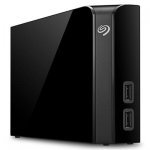
Check the product name... Seagate Backup Plus Hub... this is intended as a backup drive, and should be used as a backup drive, not a primary storage drive. There is no real issue from a backup drive failing, because this holds a COPY of the data that resides on another drive.
If you don't know the difference between primary storage and backup storage, then please refrain from entering any related discussions!!! Instead, spend your time checking on the sixty four 128GB drives that you are using to protect yourself from significant data loss.
bubblegum2910
20 Mar 17#5
True
Kallb123
20 Mar 172#6
But going with that logic, you'd have the same chance of failure, but only lose half the data.
I'm sure I've read that the larger drives fail more frequently anyway, so multiple smaller ones might be preferable to both reduce chance of total failure and bring overall failure rate down as well.
Yaradabbadoo
20 Mar 178#7
Buying a Seagate product increases failure rate exponentially!
I can't fault your logic. There is the same chance of one of these failing as an 8TB drive - even though there are 5 and a half million of them! I agree to an extent that a new 6/7/8-platter drive will contain some new and untested technology and be at a greater risk of failure than a single platter drive, but all of my 2TB drives contain 4 or 5 platters anyway. I'm not at all convinced that an appreciable difference exists. (4 or 5 platters would have been new and untested technology when I bought them). Taking an extreme approach (as I have with the floppys), I would prefer to have fewer drives of larger capacity. My old 500GB drives are now almost useless to me for backing up films, and the same will be true of my 2TB's much sooner than my 4TB's.
JoeSpur
20 Mar 17#10
I bet you are one of those people who still think Duracell batteries are 100x better than all other brands :laughing:

![Fresh Breakfast Meat Box (Using code) @ Campbells Meat [Haggis / Lorne Sausage / Bacon / Black Pudding & More]](/images/topics/208684_1.jpg)































![[Xbox One] Q. u. b. e: Director's Cut on Deals with Gold](/images/topics/208716_1.jpg)














Opening post
8 is a lot of legs, David
Top comments
Potatoes potatoes.
I can't fault your logic. There is the same chance of one of these failing as an 8TB drive - even though there are 5 and a half million of them! I agree to an extent that a new 6/7/8-platter drive will contain some new and untested technology and be at a greater risk of failure than a single platter drive, but all of my 2TB drives contain 4 or 5 platters anyway. I'm not at all convinced that an appreciable difference exists. (4 or 5 platters would have been new and untested technology when I bought them). Taking an extreme approach (as I have with the floppys), I would prefer to have fewer drives of larger capacity. My old 500GB drives are now almost useless to me for backing up films, and the same will be true of my 2TB's much sooner than my 4TB's.
All comments (38)
cheers
Potatoes potatoes.
Check the product name... Seagate Backup Plus Hub... this is intended as a backup drive, and should be used as a backup drive, not a primary storage drive. There is no real issue from a backup drive failing, because this holds a COPY of the data that resides on another drive.
If you don't know the difference between primary storage and backup storage, then please refrain from entering any related discussions!!! Instead, spend your time checking on the sixty four 128GB drives that you are using to protect yourself from significant data loss.
I'm sure I've read that the larger drives fail more frequently anyway, so multiple smaller ones might be preferable to both reduce chance of total failure and bring overall failure rate down as well.
http://www.digitaltrends.com/computing/backblaze-tests-seagate-8tb-drives-reliable/#ixzz4bsuAGLxv
I can't fault your logic. There is the same chance of one of these failing as an 8TB drive - even though there are 5 and a half million of them! I agree to an extent that a new 6/7/8-platter drive will contain some new and untested technology and be at a greater risk of failure than a single platter drive, but all of my 2TB drives contain 4 or 5 platters anyway. I'm not at all convinced that an appreciable difference exists. (4 or 5 platters would have been new and untested technology when I bought them). Taking an extreme approach (as I have with the floppys), I would prefer to have fewer drives of larger capacity. My old 500GB drives are now almost useless to me for backing up films, and the same will be true of my 2TB's much sooner than my 4TB's.