I have been following this for a while. The price comes down today to £44.99 and it feels like a good deal to me.
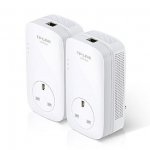
HomePlug AV2 standard compliant
High-speed data transfer rates of up to 1200 Mbps
Gigabit port provides secure wired networks
Integrated power socket ensures no power outlet goes to waste
3 years warranty
Top comments
Lexeus
2 Jul 163#6
The answer is pretty much certainly yes to will they connect, but these are AV1200 speed and if your old ones are AV 500 or AV200 then these will just run at the fastest speed that your old homeplugs will support, i.e. you are probably wasting your money as these are the expensive new ones.
I think by 'is there a limit' you mean can you have as many home plugs on your network as you want.
The answer is there is no limit, put one in every room, but I will elaborate. Think of homeplugs like cabled up WiFi, but this is a ad-hoc WiFi network (so there is no wi-fi accesspoint alike master homeplug, they are all equal) and the signal strength is usually dependant on the cable lengths and age of your electrical wiring, rather than the number and thickness of walls. So basically:
1. you can have numerous homeplugs all plugged into the same network/house from different manufacturers
2. they will run a homeplug network at the fastest homeplug standard that they all support
3. the speed of that homeplug network will not be the advertised figure (My three AV500 plugs run at 300Mbps)
Now on top of that homeplug explanation are Three further points:
1. Just like WiFi, the more homeplugs that you plug in the lower the speed the homeplug network will operate at
2. Just like WiFi, the network has overheads that will reduce your actual throughput (e.g. a AV1200 network that operate at 900Mbps may provide usfeul throughput of only 800Mbps)
3. The Homeplug network speed can be faster than the actual ethernet interface (e.g. my AV500 network operates at 300Mbps but my homeplugs only have 100Mbps ethernet interfaces)
Relating that all back to these homeplugs, that means if you are currently running a network of two AV500 homeplugs operating at 350Mbps and you buy these two AV1200 homeplugs to add to your existing network, then all four will only run at the AV500 standard and operate a network at say 300Mbps, but if your existing homeplugs are like mine and only have 100Mbps ethernet ports, then if Computer A (with a Gigabit interface) is plugged in to the Av1200 (1Gbps interface) plug and Computer B (with a Gigabit interface) is plugged into an old AV500 (100Mbps interface) plug, they will only be able to communicate at 100Mbps.
Home this helps explain the homeplug fog :smiley:
All comments (19)
daveo78
1 Jul 16#1
Great bit of kit... especially at this price I've got this kit and the three port version. Tons quicker than wifi.
ro53ben to daveo78
26 Jul 16#8
No...tons quicker than YOUR Wi-Fi, there is a difference here.
Always amazed how big the market is for this powerline stuff. It never achieves claimed speeds and it costs peanuts to run a bit of CAT5 cable.
The_IMF
1 Jul 162#2
Hot for those that are looking for these. This exact one didn't work well for me so ran cat 6 cables under floor. 100x more reliable.
buddn07
1 Jul 16#3
Hot. Shame the plug goes up. Won't fit under my shelf!
BetaRomeo to buddn07
2 Jul 162#4
If you're feeling adventurous, you could remove your wall socket and rewire it upside-down. (Don't forget to shut off the power first!) :man:
willpower to buddn07
26 Jul 161#9
... or just unscrew the faceplate and screw it back on upside down. No need for any rewiring.
buckiebull
2 Jul 16#5
will these connect to my other powerline adaptors that i have round the house and is there a limit?
Lexeus
2 Jul 163#6
The answer is pretty much certainly yes to will they connect, but these are AV1200 speed and if your old ones are AV 500 or AV200 then these will just run at the fastest speed that your old homeplugs will support, i.e. you are probably wasting your money as these are the expensive new ones.
I think by 'is there a limit' you mean can you have as many home plugs on your network as you want.
The answer is there is no limit, put one in every room, but I will elaborate. Think of homeplugs like cabled up WiFi, but this is a ad-hoc WiFi network (so there is no wi-fi accesspoint alike master homeplug, they are all equal) and the signal strength is usually dependant on the cable lengths and age of your electrical wiring, rather than the number and thickness of walls. So basically:
1. you can have numerous homeplugs all plugged into the same network/house from different manufacturers
2. they will run a homeplug network at the fastest homeplug standard that they all support
3. the speed of that homeplug network will not be the advertised figure (My three AV500 plugs run at 300Mbps)
Now on top of that homeplug explanation are Three further points:
1. Just like WiFi, the more homeplugs that you plug in the lower the speed the homeplug network will operate at
2. Just like WiFi, the network has overheads that will reduce your actual throughput (e.g. a AV1200 network that operate at 900Mbps may provide usfeul throughput of only 800Mbps)
3. The Homeplug network speed can be faster than the actual ethernet interface (e.g. my AV500 network operates at 300Mbps but my homeplugs only have 100Mbps ethernet interfaces)
Relating that all back to these homeplugs, that means if you are currently running a network of two AV500 homeplugs operating at 350Mbps and you buy these two AV1200 homeplugs to add to your existing network, then all four will only run at the AV500 standard and operate a network at say 300Mbps, but if your existing homeplugs are like mine and only have 100Mbps ethernet ports, then if Computer A (with a Gigabit interface) is plugged in to the Av1200 (1Gbps interface) plug and Computer B (with a Gigabit interface) is plugged into an old AV500 (100Mbps interface) plug, they will only be able to communicate at 100Mbps.
Home this helps explain the homeplug fog :smiley:
GuigsyUK
26 Jul 16#7
I think also (just like WiFi) these are half-duplex and broadcasting. Which means that the sum total of both your sending and receiving bandwidth for all the homeplug connected devices will be ~800Mbps... it has to be shared.
Wired ethernet connections attached to a router/switch get the maximum bandwidth in both directions.
In reality, if it's just a few devices connected to a broadband connection, you aren't going to be limited.

![Fresh Breakfast Meat Box (Using code) @ Campbells Meat [Haggis / Lorne Sausage / Bacon / Black Pudding & More]](/images/topics/208684_1.jpg)
































![[Xbox One] Q. u. b. e: Director's Cut on Deals with Gold](/images/topics/208716_1.jpg)














Opening post
HomePlug AV2 standard compliant
High-speed data transfer rates of up to 1200 Mbps
Gigabit port provides secure wired networks
Integrated power socket ensures no power outlet goes to waste
3 years warranty
Top comments
I think by 'is there a limit' you mean can you have as many home plugs on your network as you want.
The answer is there is no limit, put one in every room, but I will elaborate. Think of homeplugs like cabled up WiFi, but this is a ad-hoc WiFi network (so there is no wi-fi accesspoint alike master homeplug, they are all equal) and the signal strength is usually dependant on the cable lengths and age of your electrical wiring, rather than the number and thickness of walls. So basically:
1. you can have numerous homeplugs all plugged into the same network/house from different manufacturers
2. they will run a homeplug network at the fastest homeplug standard that they all support
3. the speed of that homeplug network will not be the advertised figure (My three AV500 plugs run at 300Mbps)
Now on top of that homeplug explanation are Three further points:
1. Just like WiFi, the more homeplugs that you plug in the lower the speed the homeplug network will operate at
2. Just like WiFi, the network has overheads that will reduce your actual throughput (e.g. a AV1200 network that operate at 900Mbps may provide usfeul throughput of only 800Mbps)
3. The Homeplug network speed can be faster than the actual ethernet interface (e.g. my AV500 network operates at 300Mbps but my homeplugs only have 100Mbps ethernet interfaces)
Relating that all back to these homeplugs, that means if you are currently running a network of two AV500 homeplugs operating at 350Mbps and you buy these two AV1200 homeplugs to add to your existing network, then all four will only run at the AV500 standard and operate a network at say 300Mbps, but if your existing homeplugs are like mine and only have 100Mbps ethernet ports, then if Computer A (with a Gigabit interface) is plugged in to the Av1200 (1Gbps interface) plug and Computer B (with a Gigabit interface) is plugged into an old AV500 (100Mbps interface) plug, they will only be able to communicate at 100Mbps.
Home this helps explain the homeplug fog :smiley:
All comments (19)
Always amazed how big the market is for this powerline stuff. It never achieves claimed speeds and it costs peanuts to run a bit of CAT5 cable.
I think by 'is there a limit' you mean can you have as many home plugs on your network as you want.
The answer is there is no limit, put one in every room, but I will elaborate. Think of homeplugs like cabled up WiFi, but this is a ad-hoc WiFi network (so there is no wi-fi accesspoint alike master homeplug, they are all equal) and the signal strength is usually dependant on the cable lengths and age of your electrical wiring, rather than the number and thickness of walls. So basically:
1. you can have numerous homeplugs all plugged into the same network/house from different manufacturers
2. they will run a homeplug network at the fastest homeplug standard that they all support
3. the speed of that homeplug network will not be the advertised figure (My three AV500 plugs run at 300Mbps)
Now on top of that homeplug explanation are Three further points:
1. Just like WiFi, the more homeplugs that you plug in the lower the speed the homeplug network will operate at
2. Just like WiFi, the network has overheads that will reduce your actual throughput (e.g. a AV1200 network that operate at 900Mbps may provide usfeul throughput of only 800Mbps)
3. The Homeplug network speed can be faster than the actual ethernet interface (e.g. my AV500 network operates at 300Mbps but my homeplugs only have 100Mbps ethernet interfaces)
Relating that all back to these homeplugs, that means if you are currently running a network of two AV500 homeplugs operating at 350Mbps and you buy these two AV1200 homeplugs to add to your existing network, then all four will only run at the AV500 standard and operate a network at say 300Mbps, but if your existing homeplugs are like mine and only have 100Mbps ethernet ports, then if Computer A (with a Gigabit interface) is plugged in to the Av1200 (1Gbps interface) plug and Computer B (with a Gigabit interface) is plugged into an old AV500 (100Mbps interface) plug, they will only be able to communicate at 100Mbps.
Home this helps explain the homeplug fog :smiley:
Wired ethernet connections attached to a router/switch get the maximum bandwidth in both directions.
In reality, if it's just a few devices connected to a broadband connection, you aren't going to be limited.