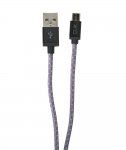
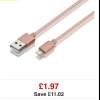
Handy as a replacement cable for your (micro usb) phone charger.
Note you don't get a power plug with this.
Bought it a few weeks ago myself and it seems to charge a lot quicker than my original HTC charger. It's also longer and feels sturdier.
Therefore, someone using a poor quality cable will notice a difference in charge times with a better cable.
hcc27 to ukhotdeals1
27 Jun 161#15
True, data transfer may not be impacted unless there is a physical break in the wires inside, however charging rates can vary widely between cables depending on the guage of conductor used which in turn impacts resistance of the wire, energy loss within the wire and the voltage delivered to the end device.
USB cables have two sets of internal cables, a pair for data and another pair for power/ charging (5V+ and GRND). Most cheap cables tend to be 28/28AWG and so have a higher resistance on the power pair compared to better quality cables which are 28/24AWG (i.e. the power cable pair are 24AWG while the data cables are 28AWG, remember the higher the guage the narrower the cross-section). Having a 24AWG cable pair compared to a 28AWG pair makes all the difference when you're charging a 3000mAh battery - there will be a significant difference in charge time between a cheapo and a decent cable.
You can check this out with a very cheap USB in-line power monitor, e.g.:
The best cables I have, bar none (even Samsung/LG supplied cables) are these by Volutz which are rated 24/19AWG - both my USB power monitor and actual empirical charge times on various devices confirm the efficiency of the power cable pair inside:
When buying USB cables:
1. Try to find one with at least a 28/24AWG cable pair inside - a pack of decent cables will last you years and put up with considerable misuse and punishment.
2. Go for the shortest length you can afford to have - remember the longer the cable the greater the resistance and loss of efficiency. NEVER use a USB extender unless you cannot absolutely avoid it - extenders kill power transmission efficiency big time.
3. Try not to 'wrap it up', twist, turn the cables etc unnecessarily. Keep the cables as straight as you can to avoid damaging the wires themselves, or the connectors, again reducing charging efficiency.
NizTizzle
27 Jun 16#8
Question! I have a Galaxy S6 Edge+ that fast charges. The cat has chewed the cable, will this cable fast charge or do I need a special cable too?!
lutin to NizTizzle
27 Jun 16#16
Good news! - I have an S6 and this does fast charge.
It's hard to get excited about a cable, but this is a very, very nice one. I'm gonna get another tomorrow I think.
It may actually be longer than you think by the way - it's certainly longer than any cable that I've ever got with a phone.
intuder
27 Jun 16#9
Nope
elbrownos
27 Jun 162#11
Doesn't everybody already have a drawer full of micro USB cables?

![Fresh Breakfast Meat Box (Using code) @ Campbells Meat [Haggis / Lorne Sausage / Bacon / Black Pudding & More]](/images/topics/208684_1.jpg)



























![[Xbox One] Q. u. b. e: Director's Cut on Deals with Gold](/images/topics/208716_1.jpg)











Opening post
Note you don't get a power plug with this.
Bought it a few weeks ago myself and it seems to charge a lot quicker than my original HTC charger. It's also longer and feels sturdier.
All comments (27)
The American wire gauge (AWG) can vary and the better leads have a lower AWG value (20 is the best you can expect to get at the moment).
The page below shows how the voltage drops with thinner wires:
http://goughlui.com/2014/10/01/usb-cable-resistance-why-your-phonetablet-might-be-charging-slow/
Therefore, someone using a poor quality cable will notice a difference in charge times with a better cable.
USB cables have two sets of internal cables, a pair for data and another pair for power/ charging (5V+ and GRND). Most cheap cables tend to be 28/28AWG and so have a higher resistance on the power pair compared to better quality cables which are 28/24AWG (i.e. the power cable pair are 24AWG while the data cables are 28AWG, remember the higher the guage the narrower the cross-section). Having a 24AWG cable pair compared to a 28AWG pair makes all the difference when you're charging a 3000mAh battery - there will be a significant difference in charge time between a cheapo and a decent cable.
You can check this out with a very cheap USB in-line power monitor, e.g.:
https://www.amazon.co.uk/PortaPow-Power-Monitor-Solar-Charger/dp/B00NTU18KY/ref=pd_sim_263_5?ie=UTF8&dpID=413hhmkMhYL&dpSrc=sims&preST=_AC_UL160_SR160%2C160_&refRID=2280A6ZNVVYKERPHKEZH
The best cables I have, bar none (even Samsung/LG supplied cables) are these by Volutz which are rated 24/19AWG - both my USB power monitor and actual empirical charge times on various devices confirm the efficiency of the power cable pair inside:
https://www.amazon.co.uk/Volutz-Equilibrium-Nylon-Braided-Micro-USB/dp/B00TE432W6/ref=sr_1_cc_1?s=aps&ie=UTF8&qid=1467042387&sr=1-1-catcorr&keywords=volutz
When buying USB cables:
1. Try to find one with at least a 28/24AWG cable pair inside - a pack of decent cables will last you years and put up with considerable misuse and punishment.
2. Go for the shortest length you can afford to have - remember the longer the cable the greater the resistance and loss of efficiency. NEVER use a USB extender unless you cannot absolutely avoid it - extenders kill power transmission efficiency big time.
3. Try not to 'wrap it up', twist, turn the cables etc unnecessarily. Keep the cables as straight as you can to avoid damaging the wires themselves, or the connectors, again reducing charging efficiency.
It's hard to get excited about a cable, but this is a very, very nice one. I'm gonna get another tomorrow I think.
It may actually be longer than you think by the way - it's certainly longer than any cable that I've ever got with a phone.