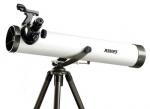
Jessops 800-80 Astronomical Telescope
An Ideal starter scope for any budding astronomer, everything required to open up the fantastic world of astronomy and bring the delights of space observation down to earth. Furthermore, the unit is supplied part assembled making the assembly process a breeze.
Although you can technically get to 399x magnification (the 6mm eyepiece with the barlow lens), the most I'd expect to get out of this is maybe 80x or 90x, maybe less (cheap glass you'll just end up seeing imperfections in the lenses).
These will show you the planets, but they won't be what you are expecting. They will be small coloured dots, maybe able to resolve a little more detail on the big planets (Jupiter and Saturn). The views of the moon would be excellent, and open clusters such as Pleiades are pleasant to look at (but unexciting for most as they just appear as pockets of stars).
As an example, I took this photo a few years ago with a 6" newtonian telescope (£150, Skywatcher 130 the one in the post is only a 4" telescope). Note the colour distortion, the obvious pattern from the cheap lens.
oobie38
31 Dec 1236#16
I took this on a12.5" rental scope.... Used to want my own, but the investment for the casual dabbler is far too much
turdburglar
31 Dec 1225#5
Would this be suitable for an aspiring peeping tom?
ZedZed
31 Dec 1223#9
Before buying please visit http://stargazerslounge.com/ so that you understand what you're getting with this sort of scope. i.e. not much.
I purchased a 2nd hand scope last year for £130 and it was miles better than this one. I still sold it on though because of the hassle of getting it out of the garage and set up, esp. when it's freezing outside (which it will be, because it'll be clear skies you want and that's when the temp drops).
My recommendation would be if £40 is what you want to spend to look at the stars, get a pair of binoculars. You're far more likely to use them (just step outside the back door and put to your eyes!) and a £40/£50 pair will give some reasonable views of the moon and some of the DSOs (dark sky objects). Part of the hobby though is really learning about the sky and understanding what you're looking at. You won't get anywhere near the images that you see on the BBC website or whatever. Not until you've spend £1k+ on a set up that allows astro photography anyway!
Just my tuppence worth.
All comments (127)
spspsp
31 Dec 12#1
Just bought this for hubbies birthday next week. So fingers crossed! £3.99 postage and delivered in 2-3 days.
canada16
31 Dec 12#2
Is it true you can only see the moon with these?
Anyone know of good ones that you can see more for less than 100.00 ?
This one gets the thumbs up from Starazing lounge for value for money, but over your £100 budget, and over £100 more than original post :neutral_face:
Crowman to canada16
31 Dec 12#22
Well, it doesn`t come with a moon filter, so no this set up (as it stands) wouldn`t be any good for moonwatching.
I totally agree with the others that recommend getting a decent set of binoculars. They`re easier to use, with no set up, plus, you can use them for other stuff, too. Amazon usually have decent Celestron binoculars for less than £50.
caterham7
31 Dec 123#3
For a reflector, 150mm mirror is generally considered minimum, this is 80mm. However, it looks better in the online pictures than the £25 telescopes that have been in the deals from supermarkets, and at that price could be worth a punt. You'd be able to see Jupiter, Saturn and Venus with it, and some of the brighter deep sky objects, as well as stars.
turdburglar
31 Dec 1225#5
Would this be suitable for an aspiring peeping tom?
mikerj to turdburglar
1 Jan 13#45
No, reflectors aren't very good for general purpose use on the ground, since the image will appear rotated by some arbitrary amount (it's the same for astronomical viewing, but it doesn't make any difference for that purpose).
JBardey
31 Dec 1241#6
Although you can technically get to 399x magnification (the 6mm eyepiece with the barlow lens), the most I'd expect to get out of this is maybe 80x or 90x, maybe less (cheap glass you'll just end up seeing imperfections in the lenses).
These will show you the planets, but they won't be what you are expecting. They will be small coloured dots, maybe able to resolve a little more detail on the big planets (Jupiter and Saturn). The views of the moon would be excellent, and open clusters such as Pleiades are pleasant to look at (but unexciting for most as they just appear as pockets of stars).
As an example, I took this photo a few years ago with a 6" newtonian telescope (£150, Skywatcher 130 the one in the post is only a 4" telescope). Note the colour distortion, the obvious pattern from the cheap lens.
scousethief
31 Dec 12#7
Im looking for a decent beginner telescope ( second hand would do just fine) are there any good recommendations ? i obviously would like to keep the cost relatively low and i dont need to be able to see the entire galaxy in an egg cup lol.
pete_l to scousethief
31 Dec 12#15
Well, with BBC1's Stargazing Live coming up in a week's time (Jan 8th ), I'd either buy before the rush, or a few weeks afterwards when everybody has become disillusioned with the cheap, crappy telescopes they impulse-bought, having watched the show.
The thing is: all these cheap telescopes are pretty useless. You really need to spend some hundreds to get one big enough to see anything worthwhile. But you also need a good, sturdy mount or it'll wobble so much that it's useless. Reckon on a starting price of £300 for an 8 inch dobsonian. Oh and don't forget, it's mostly cloudy in the UK and the light pollution will obscure most of the good stuff on the few, rare, clear nights (and buy yourself a woolly hat, too)
derek4
31 Dec 121#8
It's nice to get an insight into this, something I know nothing about.
ZedZed
31 Dec 1223#9
Before buying please visit http://stargazerslounge.com/ so that you understand what you're getting with this sort of scope. i.e. not much.
I purchased a 2nd hand scope last year for £130 and it was miles better than this one. I still sold it on though because of the hassle of getting it out of the garage and set up, esp. when it's freezing outside (which it will be, because it'll be clear skies you want and that's when the temp drops).
My recommendation would be if £40 is what you want to spend to look at the stars, get a pair of binoculars. You're far more likely to use them (just step outside the back door and put to your eyes!) and a £40/£50 pair will give some reasonable views of the moon and some of the DSOs (dark sky objects). Part of the hobby though is really learning about the sky and understanding what you're looking at. You won't get anywhere near the images that you see on the BBC website or whatever. Not until you've spend £1k+ on a set up that allows astro photography anyway!

![Fresh Breakfast Meat Box (Using code) @ Campbells Meat [Haggis / Lorne Sausage / Bacon / Black Pudding & More]](/images/topics/208684_1.jpg)










![[Xbox One] Q. u. b. e: Director's Cut on Deals with Gold](/images/topics/208716_1.jpg)










Opening post
An Ideal starter scope for any budding astronomer, everything required to open up the fantastic world of astronomy and bring the delights of space observation down to earth. Furthermore, the unit is supplied part assembled making the assembly process a breeze.
Specification:
800mm focal length
80mm objective diameter
Focal ratio: F/10
40x Minimum magnification
399x Maximum magnification
Box Contents:
Reflector telescope
6mm, 12.5mm and 20mm eyepieces
Electronic red dot finder scope (battery included)
3x Barlow lens
Aluminium tripod
Altitude slow-motion adjustment bar
expired http://www.ft.com/cms/s/0/ab04efbe-5c1b-11e2-ab38-00144feab49a.html#axzz2Hhis1Rjd
- saywhaaat
Top comments
These will show you the planets, but they won't be what you are expecting. They will be small coloured dots, maybe able to resolve a little more detail on the big planets (Jupiter and Saturn). The views of the moon would be excellent, and open clusters such as Pleiades are pleasant to look at (but unexciting for most as they just appear as pockets of stars).
As an example, I took this photo a few years ago with a 6" newtonian telescope (£150, Skywatcher 130 the one in the post is only a 4" telescope). Note the colour distortion, the obvious pattern from the cheap lens.
I purchased a 2nd hand scope last year for £130 and it was miles better than this one. I still sold it on though because of the hassle of getting it out of the garage and set up, esp. when it's freezing outside (which it will be, because it'll be clear skies you want and that's when the temp drops).
My recommendation would be if £40 is what you want to spend to look at the stars, get a pair of binoculars. You're far more likely to use them (just step outside the back door and put to your eyes!) and a £40/£50 pair will give some reasonable views of the moon and some of the DSOs (dark sky objects). Part of the hobby though is really learning about the sky and understanding what you're looking at. You won't get anywhere near the images that you see on the BBC website or whatever. Not until you've spend £1k+ on a set up that allows astro photography anyway!
Just my tuppence worth.
All comments (127)
Anyone know of good ones that you can see more for less than 100.00 ?
This one gets the thumbs up from Starazing lounge for value for money, but over your £100 budget, and over £100 more than original post :neutral_face:
I totally agree with the others that recommend getting a decent set of binoculars. They`re easier to use, with no set up, plus, you can use them for other stuff, too. Amazon usually have decent Celestron binoculars for less than £50.
These will show you the planets, but they won't be what you are expecting. They will be small coloured dots, maybe able to resolve a little more detail on the big planets (Jupiter and Saturn). The views of the moon would be excellent, and open clusters such as Pleiades are pleasant to look at (but unexciting for most as they just appear as pockets of stars).
As an example, I took this photo a few years ago with a 6" newtonian telescope (£150, Skywatcher 130 the one in the post is only a 4" telescope). Note the colour distortion, the obvious pattern from the cheap lens.
The thing is: all these cheap telescopes are pretty useless. You really need to spend some hundreds to get one big enough to see anything worthwhile. But you also need a good, sturdy mount or it'll wobble so much that it's useless. Reckon on a starting price of £300 for an 8 inch dobsonian. Oh and don't forget, it's mostly cloudy in the UK and the light pollution will obscure most of the good stuff on the few, rare, clear nights (and buy yourself a woolly hat, too)
I purchased a 2nd hand scope last year for £130 and it was miles better than this one. I still sold it on though because of the hassle of getting it out of the garage and set up, esp. when it's freezing outside (which it will be, because it'll be clear skies you want and that's when the temp drops).
My recommendation would be if £40 is what you want to spend to look at the stars, get a pair of binoculars. You're far more likely to use them (just step outside the back door and put to your eyes!) and a £40/£50 pair will give some reasonable views of the moon and some of the DSOs (dark sky objects). Part of the hobby though is really learning about the sky and understanding what you're looking at. You won't get anywhere near the images that you see on the BBC website or whatever. Not until you've spend £1k+ on a set up that allows astro photography anyway!
Just my tuppence worth.