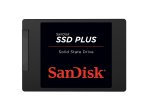
Been looking for a reasonably priced SSD for a while - this has just dropped in price so couldn't resist!
As a thought, if possible, add 'Hard drive' in the description so it shows up in such a search. :wink:
- homebanjo
I mean title, add it to the title... Damn I go on :neutral_face:
- homebanjo
Top comments
Lahn
20 Apr 1710#1
It's scary if this is considered a reasonable price... damn nand shortages :disappointed:
supermann
20 Apr 174#24
Excellent. Only £25 more than I paid for it over two years ago.
Harryisme to Lahn
20 Apr 174#2
I know right, I bought a 240GB SSD over 2 years ago for £50, I was sure by now we'd be getting 512GB Drives for this price, but the prices how been static for a while.
bentrewern
20 Apr 173#7
This is about the slowest mainstream SSD out there. You can't go by the reviews as Sandisk change the internal components without changing the model name. You can pick up the Ultra II version at PC World for £10 more which is likely to be much faster.
All comments (51)
Lahn
20 Apr 1710#1
It's scary if this is considered a reasonable price... damn nand shortages :disappointed:
Harryisme to Lahn
20 Apr 174#2
I know right, I bought a 240GB SSD over 2 years ago for £50, I was sure by now we'd be getting 512GB Drives for this price, but the prices how been static for a while.
ukez to Lahn
20 Apr 171#25
Just thumb these prices down mate, it will trickle back to the manufacturers soon or later when they realise they have boxes of them sitting on their shelf and they ain't making money and they still have bills coming in.
ikonanddiva
20 Apr 171#3
I believe I also bought my Sandisk 240GB SSD for around £45-£50 12-18 months ago.
£70 just doesn't look tempting at all for 240GB, even if it is today's prices. Hot if the deal was for 480GB...
But for those who still aren't using a Solid State Drive (SSD) yet...get one!
James2505
20 Apr 171#4
Not voted, but on Amazon you can get the 250GB SK Hynix SL308 for less than £4 more and it's surely better value. Better specs and higher capacity and it's a decent brand too, just not well known to people. I have one and I'm pretty happy although I've only ever used it in a USB enclosure.
taras
20 Apr 171#5
we should see prices fall as the change from 2d nand to 3d nand (also layer increase) will be mean the easing of prices in q3 :o..
If you do need an ssd now, just go for the best gb per £.
chriskrt
20 Apr 171#6
It was 40 quid at prime day. BTW, if You can get amazon fresh, You could get it for 50 with code.
bentrewern
20 Apr 173#7
This is about the slowest mainstream SSD out there. You can't go by the reviews as Sandisk change the internal components without changing the model name. You can pick up the Ultra II version at PC World for £10 more which is likely to be much faster.
last Prime day had the ultra version at twice the capacity for £5 more than this, wishing id bought a couple more now.
Gkains
20 Apr 172#10
That would have just about been possible, but those who back then expected to get 1TB or more for this price were always likely to be disappointed.
I wouldn't be that sure that 3D and similar stuff will reduce prices by much as there are now so few players left. The economics of NAND (and RAM) are not getting any easier. The fixed costs ($billion fabs) are going up, the R&D required is going, the number of players is going down. And at best margins are, if averaged over a decade, rather low. I'm sure ATM all the remaining manufacturers are making good margins, but the reason others went out of the business is because they didn't or rather were making losses. Sustaining a business with losses and gambling on the hope that your competitors will go bankrupt and in the subsequent shortage you will make up for your losses only works for the largest player. Certainly commodity NAND and RAM manufacturers can only dream of the 60%+ margins the likes of Intel, Qualcomm, etc. enjoy.
Uncommon.Sense
20 Apr 172#11
People seriously need to understand that NAND is like oil when it comes to pricing, it directly effects how much you pay for the end product, just as oil effects the price you pay per litre of fuel for your car.
The price is predicted to continue trending upwards until Q3 this year when hopefully it will plateau, but with the goings on with Korea, and the whole N. Korea vs U.S.A. then I would be hedging and buying now if you need one. :smiley:
fishmaster to Uncommon.Sense
20 Apr 17#31
Hows the North Korea versus USA situation which isn't a situation going to affect anything? North Korea don't have any power to dictate anything, there's nothing Trump needs to do anyway, just let them get on with making their cardboard missiles.
Everything has gone up due to the weak £, the £ will remain weak whilst there's uncertainty, there will be uncertainty for quite some time.
png666 to Uncommon.Sense
21 Apr 17#37
I think this year is optimistic, ignoring the end of the world scenario, the collapse of the £, I think will keep prices up well into 2018.
Glad I finished my drive up grade program Xmas 2015.
GwanGy
20 Apr 172#12
nan SHORTAGES? I thought everyone was living longer than ever :smile:
Actually isn't TOSHIBA (the 2nd biggest fabber of NAND) wants to sell off its nand division as its got into a bit of bother over its (GE's) nuclear liabilitys.
And maybe the chinese might start nibbling at the bottom end of the market...
ro53ben
20 Apr 171#13
SATA SSD getting a bit long in the tooth now, M.2 PCI-E all the way now.
Agree with the post above about the Sandisk Ultra II drives being worth the extra but it's all a bit slow next to PCI-E based tech.
118luke to ro53ben
20 Apr 171#17
Thats all well and good providing you have a board/laptop that supports M.2.
The beauty about SATA based SSDs is that virtually every single laptop and PC can use them.
Only my main laptop has an M.2 slot, but my i7 6700k Skylake Asus Pro-Gaming Z170 board in my PC does not (and its not an ancient motherboard either) - so i use 2x 500GB ssds in raid.
EDIT: According to the manual, it does infact have an M2 slot?? Cant say i noticed it when installing it though. :man:
paulpso to ro53ben
20 Apr 17#19
I dunno. Sata3 is still faster than pretty much all drives. Unless you go for one of the crazy fast big pci-e card drives. Probably majority SATA cause of compatibility. A lot of boards still don't have mini slots. Thought tbh I thought the big pci-e cards would have taken off more given the crazy speeds they can offer.
Tesco_horse_meat
20 Apr 17#14
Cold - horse poo expensive
ro53ben
20 Apr 171#15
Funny how people keep saying this is expensive when I used to be £1/GB when SATA SSD first came out.
Just because you can't/won't afford it, doesn't make it expensive. M2 PCIe drives at ~50p/GB aren't even expensive, a total bargain in fact for what you get.
cainer1 to ro53ben
20 Apr 171#16
my 1st SSD was £310 for 100GB :confused:
rvcshart to ro53ben
20 Apr 17#28
I paid a lot more than £1 per GB...
taras
20 Apr 171#18
if you have a uefi bios, that supports pcie booting, you can use a pci-e x4 slot for m.2 cards (need a converter card)
taras
20 Apr 17#20
it increases capacity per chip. plus theres been a decrease in capacity whilst those plants are updated and validated. So prices will come down either physically or via increased capacity at the same price ..
ro53ben
20 Apr 171#21
My first HDD was £205 for 200MB - yes, megs, not gigs. :stuck_out_tongue:
ro53ben
20 Apr 171#22
Aside from laptops - which basically are bought to knowing they can't really be upgraded in any significant way - you should be able to add an M.2 adapter card into any reasonably modern PC.
Worth noting, there are two M.2 types. The SATA one offers little advantage over the SSD drive in this deal. It's the PCIe NVMe drive you really want.
SATA SSD is 2-3 times quicker than HDD.
PCIe NVMe SSD is 5-6 times quicker than SSD!
ro53ben
20 Apr 17#23
LIke I said above SATA3 is slow. SATA3 is limited to around 600MB/s, I'm getting 3200MB/s from my Samsung EVO 960 M.2 PCIe.
supermann
20 Apr 174#24
Excellent. Only £25 more than I paid for it over two years ago.
alanbeenthere
20 Apr 171#26
Which is a nice number if all you do is move large files around.
The reason I went nvme is for the 330,000 iops on 4k read/writes. Much more meaningful in everyday use.
I hope samsung and micron can sort out the yeild issues at the new fabs quickly.
Gkains
20 Apr 171#27
I know you were quick to dismiss laptops, but anyone who is looking for a M.2 drive for a laptop:
Worth noting, there are two M.2 types (SATA and PCIe NVMe) AND
There are at least five physical sizes:
2243
2260
2280
22110
Desktop motherboards and adapters tend to support all five of those, laptop not necessarily so even where they have the space. Oh, those 3200MB/s NVMe drives tend to run hot (although they will throttle to save themselves) which is another thing laptop users need to consider.
EDIT: just in case that's not complex enough, the wiki says
"The M.2 standard allows module widths of 12, 16, 22 and 30 mm, and lengths of 16, 26, 30, 38, 42, 60, 80 and 110 mm." https://en.wikipedia.org/wiki/M.2#Form_factors_and_keying
Decentbloke
20 Apr 171#29
BREXIT = devalued £
devalued £ = more expensive imports
Simples
brilly
20 Apr 17#30
in straight sequential speeds, which are basically irrelevant
BungalowBill
20 Apr 17#32
This just proves how young you are. My Amstrad 1640 was my first PC with a hard disk and it only had 30Mb.
Decentbloke
20 Apr 17#33
You don't know how old he was when he got it ;-]
ro53ben
20 Apr 17#34
Ha, indeed. I used my dad's PCs until that point, the earlier ones of which didn't have hard disks either. This was the first one i bought with my own money.
taras
20 Apr 17#35
the raw speed measured in bytes per second, is important, you need it for iops, pointless if your nand can access it vey fast but the track to the other destination. Same for the iops,
Fast iops is important for reading lots of data simultaneously quickly - ie thumbnails, folders, booting etc even when you are bashing your page file.
raw speed is usefull when you are putting your computer to sleep/waking and booting. plus large files.
Mixed iops where the device reads and writes to the device at the same time, is very very important to an os drive
Optimus_Toaster
20 Apr 172#36
Well that's just downright misleading. HDD to SATA SSD is day and night difference. SATA SSD to NVME SSD is day and 1 minute later that day.
Uncommon.Sense
21 Apr 17#38
SK Hynix, Samsung - They are in South Korea, along with fabrication plants for said companies that produce the NAND flash, DRAM etc. So taking a couple of plants offline due to disruption for political events, should such a thing occur would be devastating, for the world and no not just because of the NAND!
As for the currency comments, that is pretty minor, since we are talking commodity products they take daily adjustments, and given that the dollar is only 12.5 cents below the average for the first half of 2016, that only adds about 8%, not 50-100% price increases which is what is happening due to the NAND shortage. :smiley:
Lahn
21 Apr 17#39
I didn't vote on this deal - It might be the best price currently, but I personally think it's a terrible deal...
ro53ben
21 Apr 17#40
No, it's just a simple fact. A modern game with an install time of say 6 minutes on SATA will install in 1 minute on PCIe NVMe. Likewise a game with a load time of 1 minute will run in about 10 seconds on the m.2 drive.
Here are some stats, firstly from a Sandisk Ultra II SSD on SATA:
I have no doubt that NVME SSDs are very fast - I own an SM951 - but to say they are "SATA SSD is 2-3 times quicker than HDD. PCIe NVMe SSD is 5-6 times quicker than SSD!" is untrue unless all you do is copy data around all day.
ro53ben
21 Apr 17#46
Having a drive that is 5-6 times quicker is no use unless you:
1) Install games
2) Play games
3) Edit video files
4) Rip/convert audio files
5) Rip/convert video files.
6) Install OS updates
7) Use a paging file.
Otherwise they are no use at all. But in that case you may as well be using a netbook or tablet as you don't need a PC to browse the internet or write a Word document.
fishmaster to ro53ben
21 Apr 17#47
I can tell you from first hand experience as I've sold over 7,000 laptops that SSDs do matter for everyday use.
A conventional hard drive is the major bottleneck in any computer system, once SSDs came about 10 years ago this changed, they were pretty ropey then, but any computer I buy now has to have an SSD in it even if I was just browsing the Internet. They massively improve OS performance, of course you could just argue that you boot up your PC and wait and then wait for the browser to open etc, of course you can, however when you multiply that waiting time by the amount of times you use the computer it becomes obvious that an SSD just gives an overall better user experience. Once you've used a PC with an SSD you just wouldn't want to go back to using a conventional HDD.
png666
21 Apr 17#48
Don't forget about lower energy use with an SSD.
alanbeenthere
21 Apr 172#49
I think the comparison was SSD to nvme.
anonimousse
21 Apr 17#50
Zzz..
fishmaster
21 Apr 17#51
There's other letters in the alphabet that you can use to form sentences with, it's fun, have a go sometime :smiley:

![Fresh Breakfast Meat Box (Using code) @ Campbells Meat [Haggis / Lorne Sausage / Bacon / Black Pudding & More]](/images/topics/208684_1.jpg)


































![[Xbox One] Q. u. b. e: Director's Cut on Deals with Gold](/images/topics/208716_1.jpg)















Opening post
As a thought, if possible, add 'Hard drive' in the description so it shows up in such a search. :wink:
- homebanjo
I mean title, add it to the title... Damn I go on :neutral_face:
- homebanjo
Top comments
All comments (51)
£70 just doesn't look tempting at all for 240GB, even if it is today's prices. Hot if the deal was for 480GB...
But for those who still aren't using a Solid State Drive (SSD) yet...get one!
If you do need an ssd now, just go for the best gb per £.
I wouldn't be that sure that 3D and similar stuff will reduce prices by much as there are now so few players left. The economics of NAND (and RAM) are not getting any easier. The fixed costs ($billion fabs) are going up, the R&D required is going, the number of players is going down. And at best margins are, if averaged over a decade, rather low. I'm sure ATM all the remaining manufacturers are making good margins, but the reason others went out of the business is because they didn't or rather were making losses. Sustaining a business with losses and gambling on the hope that your competitors will go bankrupt and in the subsequent shortage you will make up for your losses only works for the largest player. Certainly commodity NAND and RAM manufacturers can only dream of the 60%+ margins the likes of Intel, Qualcomm, etc. enjoy.
The price is predicted to continue trending upwards until Q3 this year when hopefully it will plateau, but with the goings on with Korea, and the whole N. Korea vs U.S.A. then I would be hedging and buying now if you need one. :smiley:
Everything has gone up due to the weak £, the £ will remain weak whilst there's uncertainty, there will be uncertainty for quite some time.
Glad I finished my drive up grade program Xmas 2015.
Actually isn't TOSHIBA (the 2nd biggest fabber of NAND) wants to sell off its nand division as its got into a bit of bother over its (GE's) nuclear liabilitys.
And maybe the chinese might start nibbling at the bottom end of the market...
Agree with the post above about the Sandisk Ultra II drives being worth the extra but it's all a bit slow next to PCI-E based tech.
The beauty about SATA based SSDs is that virtually every single laptop and PC can use them.
Only my main laptop has an M.2 slot, but my i7 6700k Skylake Asus Pro-Gaming Z170 board in my PC does not (and its not an ancient motherboard either) - so i use 2x 500GB ssds in raid.
EDIT: According to the manual, it does infact have an M2 slot?? Cant say i noticed it when installing it though. :man:
Just because you can't/won't afford it, doesn't make it expensive. M2 PCIe drives at ~50p/GB aren't even expensive, a total bargain in fact for what you get.
Worth noting, there are two M.2 types. The SATA one offers little advantage over the SSD drive in this deal. It's the PCIe NVMe drive you really want.
SATA SSD is 2-3 times quicker than HDD.
PCIe NVMe SSD is 5-6 times quicker than SSD!
The reason I went nvme is for the 330,000 iops on 4k read/writes. Much more meaningful in everyday use.
I hope samsung and micron can sort out the yeild issues at the new fabs quickly.
Worth noting, there are two M.2 types (SATA and PCIe NVMe)
AND
There are at least five physical sizes:
2243
2260
2280
22110
Desktop motherboards and adapters tend to support all five of those, laptop not necessarily so even where they have the space. Oh, those 3200MB/s NVMe drives tend to run hot (although they will throttle to save themselves) which is another thing laptop users need to consider.
EDIT: just in case that's not complex enough, the wiki says
"The M.2 standard allows module widths of 12, 16, 22 and 30 mm, and lengths of 16, 26, 30, 38, 42, 60, 80 and 110 mm."
https://en.wikipedia.org/wiki/M.2#Form_factors_and_keying
devalued £ = more expensive imports
Simples
Fast iops is important for reading lots of data simultaneously quickly - ie thumbnails, folders, booting etc even when you are bashing your page file.
raw speed is usefull when you are putting your computer to sleep/waking and booting. plus large files.
Mixed iops where the device reads and writes to the device at the same time, is very very important to an os drive
As for the currency comments, that is pretty minor, since we are talking commodity products they take daily adjustments, and given that the dollar is only 12.5 cents below the average for the first half of 2016, that only adds about 8%, not 50-100% price increases which is what is happening due to the NAND shortage. :smiley:
Here are some stats, firstly from a Sandisk Ultra II SSD on SATA:
-----------------------------------------------------------------------
CrystalDiskMark 5.2.1 x64 (C) 2007-2017 hiyohiyo
Crystal Dew World : http://crystalmark.info/
-----------------------------------------------------------------------
* MB/s = 1,000,000 bytes/s [SATA/600 = 600,000,000 bytes/s]
* KB = 1000 bytes, KiB = 1024 bytes
Sequential Read (Q= 32,T= 1) : 555.347 MB/s
Sequential Write (Q= 32,T= 1) : 477.077 MB/s
Random Read 4KiB (Q= 32,T= 1) : 395.607 MB/s [ 96583.7 IOPS]
Random Write 4KiB (Q= 32,T= 1) : 257.966 MB/s [ 62980.0 IOPS]
Sequential Read (T= 1) : 502.998 MB/s
Sequential Write (T= 1) : 481.261 MB/s
Random Read 4KiB (Q= 1,T= 1) : 30.578 MB/s [ 7465.3 IOPS]
Random Write 4KiB (Q= 1,T= 1) : 69.426 MB/s [ 16949.7 IOPS]
Test : 1024 MiB [D: 60.6% (406.6/670.6 GiB)] (x5) [Interval=5 sec]
Date : 2017/04/21 9:58:57
OS : Windows 10 Professional [10.0 Build 15063] (x64)
And now the Samsung EVO 960 M.2 PCIe NVMe drive.
-----------------------------------------------------------------------
CrystalDiskMark 5.2.1 x64 (C) 2007-2017 hiyohiyo
Crystal Dew World : http://crystalmark.info/
-----------------------------------------------------------------------
* MB/s = 1,000,000 bytes/s [SATA/600 = 600,000,000 bytes/s]
* KB = 1000 bytes, KiB = 1024 bytes
Sequential Read (Q= 32,T= 1) : 2937.557 MB/s
Sequential Write (Q= 32,T= 1) : 1866.776 MB/s
Random Read 4KiB (Q= 32,T= 1) : 1011.961 MB/s [247060.8 IOPS]
Random Write 4KiB (Q= 32,T= 1) : 984.013 MB/s [240237.5 IOPS]
Sequential Read (T= 1) : 1203.288 MB/s
Sequential Write (T= 1) : 1848.416 MB/s
Random Read 4KiB (Q= 1,T= 1) : 59.518 MB/s [ 14530.8 IOPS]
Random Write 4KiB (Q= 1,T= 1) : 178.813 MB/s [ 43655.5 IOPS]
Test : 1024 MiB [E: 72.8% (678.5/931.5 GiB)] (x5) [Interval=5 sec]
Date : 2017/04/21 10:06:23
OS : Windows 10 Professional [10.0 Build 15063] (x64)
Same workstation, minutes apart. Real word tests.
Edit: Worth adding stats for my OCZ Vertex 3 SATA3 SSD here:
-----------------------------------------------------------------------
CrystalDiskMark 5.2.1 x64 (C) 2007-2017 hiyohiyo
Crystal Dew World : http://crystalmark.info/
-----------------------------------------------------------------------
* MB/s = 1,000,000 bytes/s [SATA/600 = 600,000,000 bytes/s]
* KB = 1000 bytes, KiB = 1024 bytes
Sequential Read (Q= 32,T= 1) : 223.583 MB/s
Sequential Write (Q= 32,T= 1) : 146.690 MB/s
Random Read 4KiB (Q= 32,T= 1) : 91.903 MB/s [ 22437.3 IOPS]
Random Write 4KiB (Q= 32,T= 1) : 143.483 MB/s [ 35030.0 IOPS]
Sequential Read (T= 1) : 213.706 MB/s
Sequential Write (T= 1) : 145.556 MB/s
Random Read 4KiB (Q= 1,T= 1) : 21.064 MB/s [ 5142.6 IOPS]
Random Write 4KiB (Q= 1,T= 1) : 122.988 MB/s [ 30026.4 IOPS]
Test : 1024 MiB [O: 28.4% (63.6/223.6 GiB)] (x5) [Interval=5 sec]
Date : 2017/04/21 10:16:58
OS : Windows 10 Professional [10.0 Build 15063] (x64)
Pretty poor. All SSDs are not the same.
Price gone up
https://forums.overclockers.co.uk/threads/anyone-notice-the-performance-gain-from-sata3-ssd-to-nvme-drives.18776839/
https://forums.overclockers.co.uk/threads/m-2-nvme-pci-e-3-0-x-4-solid-state-drive-vs-samsung-840-real-world.18772812/
https://forums.overclockers.co.uk/threads/os-to-m-2-ssd-any-noticeable-difference-between-speeds.18766103/
https://forums.overclockers.co.uk/threads/spec-me-an-m2-ssd-for-windows.18767243/
Some videos too
https://www.youtube.com/watch?v=l6Y6VdXO5es
https://www.youtube.com/watch?v=EdF_aerWcW8
I have no doubt that NVME SSDs are very fast - I own an SM951 - but to say they are "SATA SSD is 2-3 times quicker than HDD. PCIe NVMe SSD is 5-6 times quicker than SSD!" is untrue unless all you do is copy data around all day.
1) Install games
2) Play games
3) Edit video files
4) Rip/convert audio files
5) Rip/convert video files.
6) Install OS updates
7) Use a paging file.
Otherwise they are no use at all. But in that case you may as well be using a netbook or tablet as you don't need a PC to browse the internet or write a Word document.
A conventional hard drive is the major bottleneck in any computer system, once SSDs came about 10 years ago this changed, they were pretty ropey then, but any computer I buy now has to have an SSD in it even if I was just browsing the Internet. They massively improve OS performance, of course you could just argue that you boot up your PC and wait and then wait for the browser to open etc, of course you can, however when you multiply that waiting time by the amount of times you use the computer it becomes obvious that an SSD just gives an overall better user experience. Once you've used a PC with an SSD you just wouldn't want to go back to using a conventional HDD.