Unable to paste the url in the designated field (iPhone) so here it is below. Am sure someone will be able to sort it out.
Top comments
ChriisM to skoda441
30 Jun 1612#3
You can make a living from making ethernet cables? Impressive.
verbumSapienti
1 Jul 165#12
says the crimp virgin
skoda441
30 Jun 165#4
I work for a company that makes lots of different network cables and fibre cables not just cat5e and cat6e cables
skoda441
30 Jun 164#2
I make cat5e and cat6e cables for a living and never have a problem strip the jacket 25mm and straighten the cables with the shaft of a thin screwdriver then group them into colour code cut down to aprox 10mm and push into connector or if cat6 it should come with a little black guide piece that the wires go in first then into the connector
Latest comments (44)
jasee
9 Jul 16#44
I don't usually have to feed them through small holes as I use solid core cable to sockets. (As I said, I don't have any difficulty maintaining the twists with sockets) The only time I use male to male cables is the short run from the socket to each pc, this needs some slack anyway. At the other end, I have sockets lined up a fixed distance from the router, so standard 0.5 metre cables work with that.
pibpob
9 Jul 16#43
On the other hand, cable lengths up to 100m are specified, and as you are very unlikely to get near that in the home, you can accommodate some issues in a less than ideal connection because there will be correspondingly less loss in the cable.
Terminating your own cables is useful for two reasons: you can make them exactly the length you want, and you can feed them through small holes.
An interesting article, but, as anyone who has written for Wikipedia knows, your 'job' is to regurgitate citations, for the user, it's the citations that are important, and there aren't many here. Articles which begin 'needs additional citations for verification' require just that :smiley: I think it has always been common knowledge that the twists need to be maintained, this may simply be 'best practice' in reality. in a home network, there are few connections anyway. I still think it's better to buy than make, a good cable should have been tested anyway in ways that the ordinary user cannot, and I don't mean using a simple cable tester! Nowadays even home networks require considerable bandwidth, there are many reasons for a failure to achieve necessary speed, so it is good to think that physical connections are not one of them :smiley:
frownbreaker
8 Jul 16#40
Apologies.
The post I was commenting on has a number of incorrect statements. 1) Signal to noise not relevant as Cat5 can run Gigabit well cover 100m 2) There is talk about maintaining the twists - again not correct. 3) There is talk of not getting megabit speeds even damp string will get that type of speed I think the writer meant to say Gigabit.
The twist frequency needs to be understood in the context of why we twist the cables in the first place. Early network cables were thick and heavy they used metal shielding to protect the cables from interference. Modern network cables have less (or no) shielding. This makes them thinner, more flexible and cheaper. To cope with interference modern cable have data sent along a pair of wires known as a balanced pair. "In balanced pair operation, the two wires carry equal and opposite signals and the destination detects the difference between the two. This is known as differential mode transmission. Noise sources introduce signals into the wires by coupling of electric or magnetic fields and tend to couple to both wires equally. The noise thus produces a common-mode signal which is canceled at the receiver when the difference signal is taken.
This method starts to fail when the noise source is close to the signal wires; the closer wire will couple with the noise more strongly and the common-mode rejection of the receiver will fail to eliminate it. This problem is especially apparent in telecommunication cables where pairs in the same cable lie next to each other for many miles. One pair can induce crosstalk in another and it is additive along the length of the cable. Twisting the pairs counters this effect as on each half twist the wire nearest to the noise-source is exchanged.
Providing the interfering source remains uniform, or nearly so, over the distance of a single twist, the induced noise will remain common-mode. Differential signaling also reduces electromagnetic radiation from the cable, along with the associated attenuation allowing for greater distance between exchanges.
The twist rate (also called pitch of the twist, usually defined in twists per meter) makes up part of the specification for a given type of cable. When nearby pairs have equal twist rates, the same conductors of the different pairs may repeatedly lie next to each other, partially undoing the benefits of differential mode. For this reason it is commonly specified that, at least for cables containing small numbers of pairs, the twist rates must differ." - Taken from https://en.wikipedia.org/wiki/Twisted_pair
the__cat
2 Jul 16#39
No, don't get me wrong, I know how it could be helpful, but really it's not that hard to make a cable with the wires in the correct holes. I know it sometimes does happen, but paying 3x as much for connectors is a false economy when you consider how many you'd probably get wrong if you were making a few.
pibpob
2 Jul 16#38
All connectors are transparent, but because the wires have fine such stripes on them it's still easy to get it wrong. Another advantage of this connector is that there is no risk of any cores being too short.
Edit: sorry, Spannerzone has already made these points.
Neilatrix
1 Jul 16#37
How at man ya stingey **** give me full heat x
skoda441
1 Jul 16#36
there is a art to it but practice makes perfect it's easy once you know the knack to it
spannerzone
1 Jul 161#35
someone that has the patience of a saint or someone that should get a new job :smile:
spannerzone
1 Jul 16#34
I've never used these either and have managed with regular plugs but these would make the job quicker for me as I'm a bit colour blind and usually sods law dictates the colour coding is lousy on the cable I'm using and if using those plugs you don't need to worry about getting the length right, just shove an inch through and you're good to go by the looks of it.
skoda441
1 Jul 16#33
I crimp about 500 hundred a day what's that make me
the__cat
1 Jul 16#32
Personally I've never terminated a RJ connector that I couldn't see the wires through before crimping. I can see how these might help, but they're not worth it for what you get IMO.
the__cat
1 Jul 16#31
Twits are never important!
simonspeakeasy
1 Jul 16#30
Nice - ordered some. Thanks for the tip. Yes they're expensive but, in my case, absolutely worth it.
jez794
1 Jul 16#29
contemplating buying one even tho I've never ever actually needed to use one.....
daytripper2k
1 Jul 16#28
Every one needs a tool for the job and mines called jim
jasee
1 Jul 16#27
Apart from the last sentence, this comment doesn't make sense to me.
emptypocketz
1 Jul 16#26
So is it worth getting these or is it just cheap and nasty quality ?
Been a right numpty in the past use to throw away so many cat 5/6 cables in the bin as soon as the connector broke off or the wire split !
Have now upgraded to snagless cat cables but kept some of the old ones which I guess could be repaired but certainly sounds a tricky process to get the wires in the right slots !
frownbreaker
1 Jul 16#25
The twists are only important over several meters they are all set to prime number frequencies to minimize the number of coincident twists. There will be material difference conferred by the last few cm.
These tools are fine for occasional use and work well. Heat++
andysubaru
1 Jul 16#24
Same with mine, which is a shame because I like the blade arrangement better on these
spannerzone
1 Jul 16#23
It's great isn't it! - shame they're about 75p a plug but would make fitting a plug take seconds rather than minutes I reckon.
pibpob
1 Jul 16#22
What a simple and effective idea.
verbumSapienti
1 Jul 16#21
maybe you terminated your cable too early. make sure it's shielded or you might get a shock
I have a pair of these that came with a kit a year or so ago..well I say have, they went in the bin.
They were useless - very poor crimp tool that failed to get a good connection and generally just did a bad job. I bought a replacement from maplin which cost £10, and that has been faultless. Just not worth the hassle Imo.
FREEZIN WOLF
1 Jul 16#17
I'll have you know I've crimped some of the most beautiful cables in the world! Sometimes crimping several cables at once.
It got very hot and sweaty at times and there was no communication afterwards.
montana78
1 Jul 16#16
Any good offer for a hdmi crimper?
bennymore
1 Jul 16#15
for the price, does it works well? I mean for RJ45, I have like this before and can't press securely fit.
CartoonHead78
1 Jul 161#14
That's 40 connectors mind, with a 100% success rate!!
mogsog
30 Jun 16#6
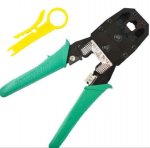
I own a pair of these, mine are rubbish and don't squeeze the rj45 connector enough for the barbs to pierce the installation. I would not recommend them, my advise would be to get a pair where you can squeeze as much as you need without the rj45 shaped hole in this pair.
M0rg0th to mogsog
1 Jul 16#13
Are you putting the RJ45 connector in the correct side of the crimper?
verbumSapienti
1 Jul 165#12
says the crimp virgin
CartoonHead78
30 Jun 161#8
I on the other hand have the exact same tool and I have successfully created over 20 cables without a problem
FREEZIN WOLF to CartoonHead78
30 Jun 163#11
Woah... 20 cables!
Are you some kind of crimping superhero?
"oh no! Who will create me a short cable to allow me to connect to this local network "
" Don't fear maa-am for I, Crimp-man, will provide you with the necessary cabling, terminals and education for you to create......... You get the idea
CartoonHead78
30 Jun 161#9
I will say this tho, the unguarded blade is lethal, you will need to put an elastic around the handles to hold it shut when u store it otherwise expect some cuts when you grab it !!
skoda441 to CartoonHead78
30 Jun 161#10
I would be tempted to take the blade off as it comes with a cutting tool so no need for it
dead4red69
30 Jun 163#5
This deal is a complete let down, I was expecting something to help me perfect a four way crimp...
I was totally expecting what I saw when I clicked that link!
skoda441
30 Jun 165#4
I work for a company that makes lots of different network cables and fibre cables not just cat5e and cat6e cables
skoda441
30 Jun 164#2
I make cat5e and cat6e cables for a living and never have a problem strip the jacket 25mm and straighten the cables with the shaft of a thin screwdriver then group them into colour code cut down to aprox 10mm and push into connector or if cat6 it should come with a little black guide piece that the wires go in first then into the connector
ChriisM to skoda441
30 Jun 1612#3
You can make a living from making ethernet cables? Impressive.
jasee
30 Jun 16#1
The main trouble with these tools is maintaining the twists of the pairs of wires AND THEN get them in the very small individual holes. Yes, it's easy to get them in if you push then straight it, but unless you maintain the twists, you won't get good signal to noise ratio and you won't get full speed, particularly at megabit speeds. They will work, of course. It's possible to get a special crimper that uses dies, but it's much more expensive.
Personally, I don't think it's worth the effort.
Sockets however, are much easier.
However voted hot for the price. :smiley:

![Fresh Breakfast Meat Box (Using code) @ Campbells Meat [Haggis / Lorne Sausage / Bacon / Black Pudding & More]](/images/topics/208684_1.jpg)


































![[Xbox One] Q. u. b. e: Director's Cut on Deals with Gold](/images/topics/208716_1.jpg)














Opening post
Unable to paste the url in the designated field (iPhone) so here it is below. Am sure someone will be able to sort it out.
Top comments
Latest comments (44)
Terminating your own cables is useful for two reasons: you can make them exactly the length you want, and you can feed them through small holes.
£2.49 now
The post I was commenting on has a number of incorrect statements. 1) Signal to noise not relevant as Cat5 can run Gigabit well cover 100m 2) There is talk about maintaining the twists - again not correct. 3) There is talk of not getting megabit speeds even damp string will get that type of speed I think the writer meant to say Gigabit.
The twist frequency needs to be understood in the context of why we twist the cables in the first place. Early network cables were thick and heavy they used metal shielding to protect the cables from interference. Modern network cables have less (or no) shielding. This makes them thinner, more flexible and cheaper. To cope with interference modern cable have data sent along a pair of wires known as a balanced pair. "In balanced pair operation, the two wires carry equal and opposite signals and the destination detects the difference between the two. This is known as differential mode transmission. Noise sources introduce signals into the wires by coupling of electric or magnetic fields and tend to couple to both wires equally. The noise thus produces a common-mode signal which is canceled at the receiver when the difference signal is taken.
This method starts to fail when the noise source is close to the signal wires; the closer wire will couple with the noise more strongly and the common-mode rejection of the receiver will fail to eliminate it. This problem is especially apparent in telecommunication cables where pairs in the same cable lie next to each other for many miles. One pair can induce crosstalk in another and it is additive along the length of the cable. Twisting the pairs counters this effect as on each half twist the wire nearest to the noise-source is exchanged.
Providing the interfering source remains uniform, or nearly so, over the distance of a single twist, the induced noise will remain common-mode. Differential signaling also reduces electromagnetic radiation from the cable, along with the associated attenuation allowing for greater distance between exchanges.
The twist rate (also called pitch of the twist, usually defined in twists per meter) makes up part of the specification for a given type of cable. When nearby pairs have equal twist rates, the same conductors of the different pairs may repeatedly lie next to each other, partially undoing the benefits of differential mode. For this reason it is commonly specified that, at least for cables containing small numbers of pairs, the twist rates must differ." - Taken from https://en.wikipedia.org/wiki/Twisted_pair
Edit: sorry, Spannerzone has already made these points.
Been a right numpty in the past use to throw away so many cat 5/6 cables in the bin as soon as the connector broke off or the wire split !
Have now upgraded to snagless cat cables but kept some of the old ones which I guess could be repaired but certainly sounds a tricky process to get the wires in the right slots !
These tools are fine for occasional use and work well. Heat++
https://www.amazon.co.uk/RJ45-Connectors-CAT6-Cable-pieces/dp/B000FI9VU2
They were useless - very poor crimp tool that failed to get a good connection and generally just did a bad job. I bought a replacement from maplin which cost £10, and that has been faultless. Just not worth the hassle Imo.
It got very hot and sweaty at times and there was no communication afterwards.
Are you some kind of crimping superhero?
"oh no! Who will create me a short cable to allow me to connect to this local network "
" Don't fear maa-am for I, Crimp-man, will provide you with the necessary cabling, terminals and education for you to create......... You get the idea
https://youtu.be/G1SBQ1udYno
Personally, I don't think it's worth the effort.
Sockets however, are much easier.
However voted hot for the price. :smiley: