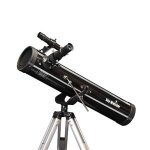
Still waiting on the Skywatcher Heritage 100P to come back in stock, but this seems like a good deal with half decent reviews, so I may opt for this instead.
Use code BINOS10
Top comments
someguy003
3 Mar 168#1
Please do not opt for this. Your original thought of getting the Skywatcher Heritage 100P was an intelligent and lucid one. Trust me!
Go an have a read through stargazers lounge forum beginners area as well there's loads of advice, and lots of horror stories.
Don't rush in and just buy a scope. If you want to get in to astrophotographers it's a fairly complex area, and you need to understand how you're going to connect the camera - from a simple clamp, to a lions or body mount. Be realistic about the kind of results you might achieve with your set up. ( whatever you end up buying).
JonF992
4 Mar 163#34
Err, no, it's on a stand that's designed to be used on the ground or a table.
Anyway, it's the wrong Heritage one to go for. This is the best beginners scope I've comes across
I was given one of these for my kids, and it's great, easy to use and with good views. I have a 250mm aperture dobsonian, and I still think the Heritage 130 is a great scope.
DistortedVision
4 Mar 163#19
I'd go for a pair of astronomical binoculars at this price point.
All comments (45)
someguy003
3 Mar 168#1
Please do not opt for this. Your original thought of getting the Skywatcher Heritage 100P was an intelligent and lucid one. Trust me!
Every inch of aperture will count at this level especially with reflector telescopes. A 4 inch (100 mm) aperture will put you in a league where you will see most things if your sky is dark enough.
Jenn101
3 Mar 16#4
Ahaaa, looking to get a decent telescope, something that I can attach a camera to, I'm not wanting anything uber expensive but I don't want to buy something that is rubbish and will be replaced in a month etc Only advice I've been given so far is to get one that avoids "light pollution" and thus far not been able to get any more advice, I've been trawling the likes of Jessops, Amazon etc and found lots with great reviews but being a HUKD'er I want to make sure i get the best in the range and good value too - so any advice would be greatly appreciated! :laughing:
someguy003 to Jenn101
3 Mar 162#5
If you live in a light polluted areas (town or city) you need to get a refractor type of telescope, which uses lenses. This telescope will be of no use to you- it is a reflector and based on mirrors. After that, it depends on money- how much you have to spend.
Jenn101
3 Mar 16#6
Hi - thanks, probably £200-£300 but more towards the £200 with the £300 quality etc :wink:
Is that any good? There's no idiots guide, so no idea if it needs a tripod, will allow me to attach a camera etc, these things are made for Etons Scientists I think
Go an have a read through stargazers lounge forum beginners area as well there's loads of advice, and lots of horror stories.
Don't rush in and just buy a scope. If you want to get in to astrophotographers it's a fairly complex area, and you need to understand how you're going to connect the camera - from a simple clamp, to a lions or body mount. Be realistic about the kind of results you might achieve with your set up. ( whatever you end up buying).
At this price point, binoculars would probably be better but if you're after a telescope, Dobsonians are easiest to use for locating objects.
And I'd recommend a zoom eyepiece like this one so that you can locate an object and then get more detail quickly without having to swap eyepieces and if you lose the object, it's quick to re-locate by zooming back out.
EQ and motorised mounts are good for tracking an object but they take a bit of setting up which could dampen the enthusiasm of youngsters.
That telescope is only a 70 mm aperture. Not really worth buying because aperture is too small at 70 mm and more expensive than the 90 mm aperture that I linked. Irrespective of what you buy, you will purchase more kit for it. It is quite an addictive hobby if you get into it. You will always want a better view of something.
Jenn101
3 Mar 16#15
Last question, what is this infamous Barlow Lens? Plus do the recommended Scopes have te ability to attach a camera at all - if not what do i need? thanks :P
someguy003 to Jenn101
3 Mar 16#16
A Barlow lens essentially doubles your magnification instantly. These are x2. But you can also get x3, x4, or even x5 Barlow or Powermates. This is really something you would add after buying your telescope. For camera attachments- what sort of camera do you want to attach?. There are adapters to attach phone, compacts and dslr for virtually all telescopes. Again you need time to consider these options
The photons do not know whether they are bouncing from a mirror or being refracted from a lens, the effects of ambient light will be the same. Reflectors will obviously be half as long for the same aperture, that is the advantage.
We have the 4" version of this telescope, it is absolutely fine for looking at the moon (except the moon moves a bit quickly - no fault of the telescope, just the physics), also good for looking at the planets, particularly Saturn's rings. The 3" version will obviously only collect 3^2/4^2 as much light, but that should be good enough to see the the first 6 planets as long as the ambient light is not too excessive.
DistortedVision
4 Mar 163#19
I'd go for a pair of astronomical binoculars at this price point.
othen to DistortedVision
4 Mar 16#21
Maybe, but you would still need a tripod to watch anything but the moon. Most binos don't come with a tripod, so you would have to factor in another £30. There is clearly no advantage in stereo vision when looking at an object as far away as (say) Mars.
othen
4 Mar 163#20
This is quite a good (although not exceptional) price for a 3" reflector with a tripod. If you just want to dabble then this would be fine. We have the 4" version (branded Jessops) that we keep at out holiday house in Norfolk (where there is not much ambient light). Obviously the larger model will collect 16/9 times as much light, but I think the 3" scope would be perfectly adequate for watching objects that don't move too fast. We have had motorised scopes in the past, which have been excellent but start at £300-£400. Most people will use this once or twice (because you need clear nights in autumn/winter when it gets dark early enough to be practical, and in a place that is remote enough to not have too much ambient light). Like a lot of pastimes, people often spend quite a lot of money setting up, then just do it once or twice, so I'd suggest this would be a perfectly good instrument to start with. Try it out a few times to see whether you mind sitting in a cold, damp field miles away from anywhere at 22:00 in November. If you don't you have only lost sixty quid; if you enjoy it you will become addicted and buy something better soon afterwards.
Heat added, this is an okay deal.
deadleg22 to othen
4 Mar 16#24
Would you recommend something like this for beginner astrophotography?
othen
4 Mar 16#22
The OP's desired instrument (Skywatcher Heritage 100P) seems to be in stock all over the place (such as):
It looks like it comes without a tripod, so one would have to factor in another £30.
kidou
4 Mar 161#25
will i be able to see aliens on the moon with this?
Md1980 to kidou
4 Mar 161#27
I don't know about that, but in 5 years you might see one in the white house!
DEALofaLifetime
4 Mar 16#26
They told me it was it out of stock at rothervalley optics when I emailed, but that they were expecting some more stock sometime this week.
londonstinks
4 Mar 16#29
3" reflector is useless.
Double up your cash and get a 6" dobsonian from skywatcher, trust me.
pcardoso73
4 Mar 161#30
I can't recommend this telescope. I have a 4.5 inch for more than 10 years, and I can tell you that is not enough !! These kind of telescopes can't gather enough light, which limits you to very bright objects (planets). Another misconception is that, usually, people think they are going to see the planets big and in colour, but the size of Saturn or Jupiter, for example, will be 2 mm or so, and of course black and white. The maximum you can zoom will be limited by the quantity of light your scope can gather, and that is proportional to the aperture. My advice would be to pay a little more and get a larger aperture one. Usually when I buy a telescope is not for selling it after 1 month, is to keep it for several years, so before buying we should think how much can we spend, and exactly what we want to see: planets, nebulas, etc....
I think an aperture that could be a good compromise between performance vs price is 150 mm (6 inches).
I hope it helps, and if I have some errors on what I have said feel free to correct me.
someguy003 to pcardoso73
5 Mar 16#41
I agree with you. I got a 5 inch Meade refractor on an amazon pricing error from £529 to £53. Instead of sending me a pricing error email- they sent me the telescope. But even with that I struggle to get good views because I live in a severely light polluted area. I think for me, at least, it was the fact that I could found and saw saturn, jupiter, pliedes and other targets for myself. This is mind-blowing for us total novices.
billy bronco
4 Mar 16#31
I want something similar to the Hubble telescope lol..
somersetpaul
4 Mar 161#32
This scope is a false economy. Remember that it is a reflector so the primary mirror is obstructed by the secondary. In a large scope this is insignificant, but at this size makes a big difference. Also that mount looks pretty poor. The best low priced scope that Jessops have is the Capricorn 70. Full 70mm aperture refractor, long focal length so ideal for planets and on a basic EQ1 mount so you can track objects more easily. At £76.49 with the discount it is a steal - the eyepieces and barlow alone are worth nearly this. Others are right about binoculars by the way. A pair of 10x50's properly mounted give wonderful bright wide angle views and can be used for bird-spotting/wildlife as well.
jaydeeuk1
4 Mar 161#33
Pretty much agree with the above. Buying a cheapo scope for a beginner is as likely to put them off than it is spark an interest. Even the brighter messier objects you'll struggle to make out unless you're lucky with light pollution.
Reflectors, particularly on a dobsonian base will give you best bang for buck, but may require collimation, and if its a 'fast' scope, you'll eventually want some decent eye pieces. The 6" skywatcher dob scope is probably the best for the cash - I didn't have the space for a dob otherwise I would have gone for that.
The other issue you always find, is that at some point you'll want to stick a camera on the end to capture clusters, galaxies etc. This opens up a whole can of worms, and unless you have very deep pockets (a 'basic' DSO astro rig that will allow you to track without error for 5 mins+ will cost north of £500) and a hell of a lot of patience and time, I wouldn't bother.
A non tracking mount like this you may be able to take images of planets, certainly the moon, put a webcam at the end (an xbox webcam, ps3 eyecam both good sub <£10 choices) take a video while planet drifts across and you'll probably get something decent. Barlow it up too much and you'll just get a mushy image at this aperture
I have a 5" maksutov on a goto tracking mount - for moon and planets nothing else out there beats it for price and performance (not suitable for DSO though). This is an image I captured last week from a 1000 frame video, stacked and (badly - too red) processed - in other words you won't see detail like this through the eyepiece.
Plus as its a slow scope, even cheapo plossl eye pieces are fine (I use a zoom 8-24mm EP)
JonF992
4 Mar 163#34
Err, no, it's on a stand that's designed to be used on the ground or a table.
Anyway, it's the wrong Heritage one to go for. This is the best beginners scope I've comes across
I was given one of these for my kids, and it's great, easy to use and with good views. I have a 250mm aperture dobsonian, and I still think the Heritage 130 is a great scope.
othen
4 Mar 16#35
Ah, I see.
fedex1401
4 Mar 16#36
Anyone have any views on the Celestron Powerseeker 127EQ as a beginners scope?
jaydeeuk1 to fedex1401
4 Mar 16#37
The scope itself is pretty decent, may get some purple fringes on the moon.
Hate manual EQ mounts for visual observing, personal preference though.
crell
4 Mar 162#38
Following my other post, I remembered this post on SGL which is brilliant at illustrating that your viewing results might be with a 4" diameter scope which is typical of people starting out or on a budget. Check out Saturn for example.
Agree its an excellent post. The book turn left at orion does sketches based on an 8" and 4" scope, its a very good book. Some other things to consider which you dont really appreciate before getting into astronomy.
1) There are very few crystal clear nights in UK, best times are in winter but this winter other than 1 or 2 nights its been awful with rain, cloud and the jetstream. Can usually tell if the stars are constantly twinkling, makes getting focus difficult.
2) If you're thinking of waiting till summer for warmer nights, be aware it doesnt get 'properly' dark until near midnight, so while planetary and moon is pleasant, forget dim galaxies
3) Viewing dimmer messier objects is near impossible on smaller scopes when the moon is in full bloom
4) An app like google sky is essential, as is finding out when planets are in conjunction. At the moment jupiter is approaching and can be seen easily in the evening - its bright. Saturn appears some time later but low in the sky. Not viewed mars through a scope yet, either rises at stupid o clock last year or cloudy, but its helpful to know when planning a session
5) Dark skies make all the difference, in perfect pitch black areas a small scope will show you far more than a 12" dob in the middle of a city, so going for aperture is good on paper but if you need to travel to see the best skys and your dob will barely fit in a car youre not gonna use it.
someguy003
5 Mar 16#40
Sorry about the late reply- I got suspended. The photons are not the problem as you said- they are just photons. The problem is the mirror. These are not perfect surfaces and bounce all light coming into the aperture through varying mirrors-whether the photon is from object light or light pollution. The result is a diminished quality of image especially if you consider that the reflector will have 3-5 mirrors in it. This is easily observed by comparing like for like aperture size of refractor and reflector in light polluted skies. The refractor will lens will focus the light you are pointing at. Lenses are much more precise things. They can be graded- achromat, ED and apo and also by make- Tak, Ohara etc. There is no grading for mirror based telescopes- well except for Hubble, which is better than any telescope I know.
someguy003
5 Mar 16#42
Zooms are great. I have a Meade Zoom for £66 quid and it is my most used eyepiece. However, Baader ClickStop Zoom is supposed to be the best
someguy003
5 Mar 16#43
Good scope and great price. We don't really know why the OP wants a small scope. Maybe space is an issue (it is for me). In that case a large reflector such as your suggestion or a dob would simply be inconvenient.
jaydeeuk1
5 Mar 16#44
The zoom eyepieces are excellent imo, i only have a cheapo 8-24mm (afaik all the brands come from same factory) is the baader parfocal? The 7-21mm is apparently a bit crap but is half the price of the 8-24mm
someguy003
5 Mar 16#45
I don't know if the Baader ClickStop Zoom is parfocal- I don't have one cos they cost over £200. I have a cheap Meade zoom I bought for £66. But reading from reviews, the Baader is rated as the best.

![Fresh Breakfast Meat Box (Using code) @ Campbells Meat [Haggis / Lorne Sausage / Bacon / Black Pudding & More]](/images/topics/208684_1.jpg)








![[Xbox One] Q. u. b. e: Director's Cut on Deals with Gold](/images/topics/208716_1.jpg)









Opening post
Use code BINOS10
Top comments
http://www.astronomy.com/observing/get-to-know-the-night-sky/2006/12/setup-is-key-when-urban-stargazing
Go an have a read through stargazers lounge forum beginners area as well there's loads of advice, and lots of horror stories.
Don't rush in and just buy a scope. If you want to get in to astrophotographers it's a fairly complex area, and you need to understand how you're going to connect the camera - from a simple clamp, to a lions or body mount. Be realistic about the kind of results you might achieve with your set up. ( whatever you end up buying).
Anyway, it's the wrong Heritage one to go for. This is the best beginners scope I've comes across
http://www.rothervalleyoptics.co.uk/skywatcher-heritage-130p-flextube-dobsonian-telescope.html
I was given one of these for my kids, and it's great, easy to use and with good views. I have a 250mm aperture dobsonian, and I still think the Heritage 130 is a great scope.
All comments (45)
:laughing:
Is that any good? There's no idiots guide, so no idea if it needs a tripod, will allow me to attach a camera etc, these things are made for Etons Scientists I think
http://www.astronomy.com/observing/get-to-know-the-night-sky/2006/12/setup-is-key-when-urban-stargazing
Go an have a read through stargazers lounge forum beginners area as well there's loads of advice, and lots of horror stories.
Don't rush in and just buy a scope. If you want to get in to astrophotographers it's a fairly complex area, and you need to understand how you're going to connect the camera - from a simple clamp, to a lions or body mount. Be realistic about the kind of results you might achieve with your set up. ( whatever you end up buying).
http://www.amazon.co.uk/Meade-StarNavigator-Refractor-Telescope-Autostar/dp/B009YLTAS4/ref=sr_1_5?ie=UTF8&qid=1457039752&sr=8-5&keywords=meade+telescope
For a non-motorised telescope you will get a larger aperture 120 mm
http://www.rothervalleyoptics.co.uk/skywatcher-startravel-120-az3-telescope.html
Both around £250 mark
thanks
http://www.amazon.co.uk/Bresser-junior-telescope-900/dp/B00ABGJNYC/ref=sr_1_3?s=electronics&ie=UTF8&qid=1457044929&sr=1-3&keywords=70+mm+telescope
And I'd recommend a zoom eyepiece like this one so that you can locate an object and then get more detail quickly without having to swap eyepieces and if you lose the object, it's quick to re-locate by zooming back out.
EQ and motorised mounts are good for tracking an object but they take a bit of setting up which could dampen the enthusiasm of youngsters.
http://www.firstlightoptics.com/beginner-telescopes.html
We have the 4" version of this telescope, it is absolutely fine for looking at the moon (except the moon moves a bit quickly - no fault of the telescope, just the physics), also good for looking at the planets, particularly Saturn's rings. The 3" version will obviously only collect 3^2/4^2 as much light, but that should be good enough to see the the first 6 planets as long as the ambient light is not too excessive.
Heat added, this is an okay deal.
http://www.rothervalleyoptics.co.uk/skywatcher-heritage-100p-dobsonian-telescope.html
It looks like it comes without a tripod, so one would have to factor in another £30.
Double up your cash and get a 6" dobsonian from skywatcher, trust me.
I think an aperture that could be a good compromise between performance vs price is 150 mm (6 inches).
I hope it helps, and if I have some errors on what I have said feel free to correct me.
Reflectors, particularly on a dobsonian base will give you best bang for buck, but may require collimation, and if its a 'fast' scope, you'll eventually want some decent eye pieces. The 6" skywatcher dob scope is probably the best for the cash - I didn't have the space for a dob otherwise I would have gone for that.
The other issue you always find, is that at some point you'll want to stick a camera on the end to capture clusters, galaxies etc. This opens up a whole can of worms, and unless you have very deep pockets (a 'basic' DSO astro rig that will allow you to track without error for 5 mins+ will cost north of £500) and a hell of a lot of patience and time, I wouldn't bother.
A non tracking mount like this you may be able to take images of planets, certainly the moon, put a webcam at the end (an xbox webcam, ps3 eyecam both good sub <£10 choices) take a video while planet drifts across and you'll probably get something decent. Barlow it up too much and you'll just get a mushy image at this aperture
I have a 5" maksutov on a goto tracking mount - for moon and planets nothing else out there beats it for price and performance (not suitable for DSO though). This is an image I captured last week from a 1000 frame video, stacked and (badly - too red) processed - in other words you won't see detail like this through the eyepiece.
Plus as its a slow scope, even cheapo plossl eye pieces are fine (I use a zoom 8-24mm EP)
Anyway, it's the wrong Heritage one to go for. This is the best beginners scope I've comes across
http://www.rothervalleyoptics.co.uk/skywatcher-heritage-130p-flextube-dobsonian-telescope.html
I was given one of these for my kids, and it's great, easy to use and with good views. I have a 250mm aperture dobsonian, and I still think the Heritage 130 is a great scope.
Hate manual EQ mounts for visual observing, personal preference though.
http://stargazerslounge.com/topic/196278-what-can-i-expect-to-see/
1) There are very few crystal clear nights in UK, best times are in winter but this winter other than 1 or 2 nights its been awful with rain, cloud and the jetstream. Can usually tell if the stars are constantly twinkling, makes getting focus difficult.
2) If you're thinking of waiting till summer for warmer nights, be aware it doesnt get 'properly' dark until near midnight, so while planetary and moon is pleasant, forget dim galaxies
3) Viewing dimmer messier objects is near impossible on smaller scopes when the moon is in full bloom
4) An app like google sky is essential, as is finding out when planets are in conjunction. At the moment jupiter is approaching and can be seen easily in the evening - its bright. Saturn appears some time later but low in the sky. Not viewed mars through a scope yet, either rises at stupid o clock last year or cloudy, but its helpful to know when planning a session
5) Dark skies make all the difference, in perfect pitch black areas a small scope will show you far more than a 12" dob in the middle of a city, so going for aperture is good on paper but if you need to travel to see the best skys and your dob will barely fit in a car youre not gonna use it.